Jobsite Toilet and Handwashing Rules for Tennessee and Georgia Contractors
Chattanooga crews often work in two states in the same month. This guide explains which agency covers each side of the line, what the federal toilet table says, and how the legal minimum differs from what keeps a crew comfortable.
Which agency sets jobsite toilet rules around Chattanooga?
Tennessee jobsites fall under TOSHA, the state-run safety plan, which adopts the federal construction standard 29 CFR 1926.51. Georgia jobsites in Ringgold, Rossville or Fort Oglethorpe fall under federal OSHA directly. Both sides of the state line use the same toilet table, so 1 crew size gets 1 answer.
TOSHA can adopt rules that are stricter than federal ones. For toilets on construction sites, Tennessee follows the federal text. Georgia does not run its own plan for private employers, so federal OSHA inspects those sites.
Crews that cross into Catoosa County, Georgia do not need a different toilet count. They may deal with a different inspector, though.
How many toilets does OSHA Table D-1 require on a jobsite?
OSHA Table D-1 in 29 CFR 1926.51(c) requires 1 toilet for 20 or fewer workers. With 20 or more workers, the table calls for 1 toilet seat and 1 urinal per 40 workers. Sites with 200 or more workers need 1 toilet seat and 1 urinal per 50 workers.
| Workers on site | Minimum under Table D-1 |
|---|---|
| 20 or fewer | 1 toilet |
| 20 or more | 1 toilet seat and 1 urinal per 40 workers |
| 200 or more | 1 toilet seat and 1 urinal per 50 workers |
A standard porta potty has a seat and a urinal in one unit. That is why many contractors count one standard unit as one seat plus one urinal.
Under temporary field conditions, the rule says at least 1 toilet must be available. The rule does not apply to mobile crews who have a vehicle ready to reach a nearby toilet.
What does OSHA 1926.51(f) say about handwashing on a jobsite?
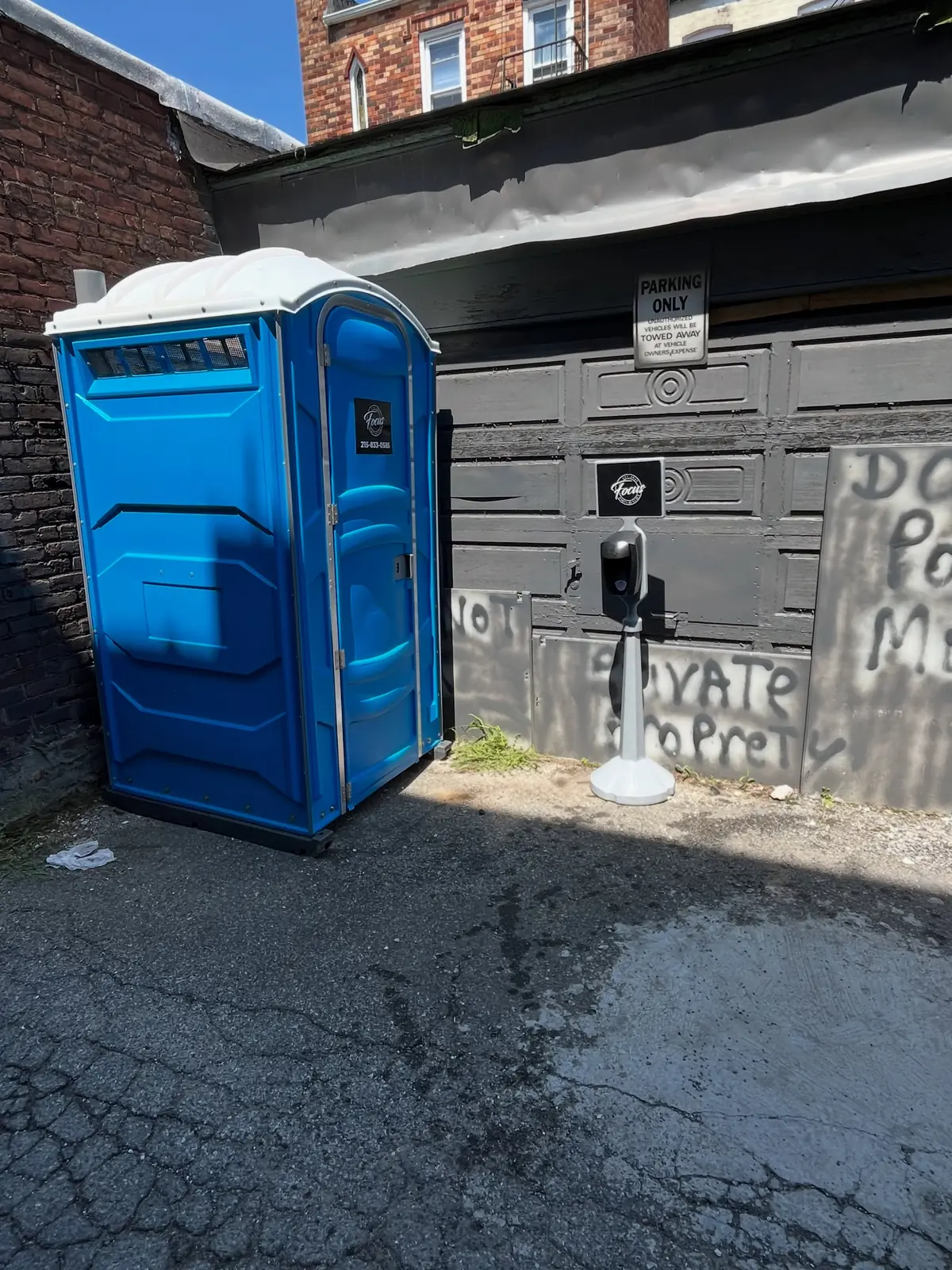
OSHA 1926.51(f) requires washing facilities near the work for crews using paints, coatings, herbicides, insecticides or other harmful substances. The facilities must let workers remove those substances and must be kept sanitary. A 2-basin hand washing station is a common way to meet that need on sites with no running water.
Painters, sealers, roofers using coatings and landscape crews spraying chemicals are the usual cases. Our hand washing station rental has two basins, foot pumps, soap and towels, and holds about 34 gallons of fresh water.
Hand sanitizer inside a toilet is not the same as a place to wash. Read the full section of the rule, or ask your safety officer, if you are not sure your work triggers it.
What is the legal minimum versus what we recommend?
The legal minimum is 1 toilet for a crew of up to 20 workers. Our business recommendation, which is not law, is 1 standard unit per 10 workers for a 40-hour week with weekly service. Above that load, the 60-gallon tank fills faster and lines form at breaks.
| Crew size | Legal minimum (Table D-1) | What we suggest (not law) |
|---|---|---|
| 1 to 10 | 1 toilet | 1 unit, weekly service |
| 11 to 20 | 1 toilet | 2 units, or 1 unit serviced twice a week |
| 21 to 40 | 1 seat and 1 urinal | 3 to 4 units, weekly service |
| 41 to 80 | 2 seats and 2 urinals | 5 to 8 units, weekly service |
Twice-weekly service is wise for 10 or more workers per unit, or in July and August heat. Our construction porta potty rental page covers weekly service and billing. For a full sizing walkthrough, see how many porta potties a site needs.
Who should confirm the toilet count for your site?
Your company safety officer or the general contractor should confirm the final toilet count for each jobsite. This article explains the federal text in plain words, but it is not legal advice. Rules and agency guidance can change, and 1 site may have contract terms that ask for more than the law does.
Before you order: check the crew count at the busiest week, not the average. Then confirm the plan with your safety lead. We will set whatever count they sign off on.
Sources
More questions on this topic
Does TOSHA require more jobsite toilets than federal OSHA?
TOSHA adopts the federal construction standard for jobsite toilets, so the Table D-1 count is the same in Tennessee. TOSHA can issue stricter rules on some topics. Ask your safety officer to confirm nothing newer applies to your trade.
Do subcontractors count toward the jobsite toilet total?
Most general contractors plan toilets for everyone on site at the busiest point, including subs. Who pays and who is responsible is usually set in the contract. Count heads at peak, then confirm with the GC.
Can one standard porta potty count as a seat and a urinal?
A standard unit has both a seat and a urinal inside one cabin. Many contractors count it that way for Table D-1. Your safety officer has the final word for your site.
How close to the work should a jobsite toilet be?
Table D-1 sets a count, not a distance. Most crews want units near the work and the parking area so trips stay short. Our truck also needs a clear path, so place the unit within about 50 feet of where it can park.
Is hand sanitizer enough to meet the handwashing rule?
Sanitizer helps, but 1926.51(f) speaks of washing facilities for crews handling harmful substances. Those crews usually need water and soap. A two-basin hand washing station is the common choice on dry sites.